Inclusive design.
The requirements for product design and development · Technical principles
Revision notes
How to consider aesthetics, ergonomics and anthropometrics when designing products (A-level only)
Aesthetics
Aesthetics refers to the visual appeal of a product, such as shape/form, size, proportion, colour and texture.
• Design writer Donald Norman says ‘products and systems which make you feel good are easier to deal with, and produce more harmonious results’.
• Balancing aesthetics and function is central to the commercial success of a product.
Shape and form
• Shape is the 2D profile, and form is the 3D physical manifestation, of a product.
• Design movements such as Art Deco and modernism developed producible and functional designs that employed primarily geometric shapes and forms.
• Tangential lines and curves result in minimal designs with pleasing, smooth surfaces.
• This approach also improves the aerodynamic performance of designs when appropriate.
Symmetry and asymmetry
• Symmetrical handheld products offer inclusivity for both left- and right-handed users.
• Symmetry gives visual balance, whereas asymmetry can add interest and focus to designs.
Proportion
• This is the relationship between the dimensions of an object, such as width and height.
• In this case it is the overall proportion of an object, but key features, controls or elements within a design can be proportionally laid out.
• Proportion significantly affects aesthetics, and the ‘golden ratio’ (1:1.6) is often used.
• This ratio results in rectangles with very pleasing proportions to the human eye.
• The ‘golden ratio’ has been used in architecture, art and design for hundreds of years.
Anthropomorphism
• This is the use of recognisably human characteristics within design.
• Examples include Alessandro Mendini’s Anna G corkscrew and the 1915 Coca-Cola bottle.
• It provides emotional, often humorous connection to products, sometimes unintentionally.
Colour and texture
• Colour is an important element in the aesthetic appeal of product designs.
• Complementary colours (opposite sides of the colour wheel) are sometimes combined.
• Analogous colours (next to each other on the colour wheel) are chosen for some situations.
Symbols and ideograms
• These are instructive symbols independent of language knowledge.
• The diversity of populations makes their use increasingly important.
• Standardisation of symbols is important and helps promote inclusivity for children.
• Intuitive use of products is helped by colour associations such as:
○ red = stop, danger, heat, warning
○ green = go, environmentally friendly
○ blue = cold
○ yellow/black combination = danger warning.
Ergonomics (human factors)
• This is defined as the scientific study of people and their working conditions.
• Interaction with products through all senses needs to be considered to avoid discomfort and stress.
• A useful exercise is to study a range of pairs of scissors for different purposes and analyse the reasons for the differences in design.
• Ergonomics factors to consider:
○ the anthropometric data range of potential users
○ the full range of abilities of possible users concerning all senses
○ the movements and forces required when using the product
○ the shape and form of parts touched by users
○ the selection of materials
○ the selection of suitable colour schemes
○ the use of appropriate symbols.
• A car dashboard is a good example of a situation with wide-ranging ergonomic requirements:
○ it must allow the driver to focus on the road and also communicate vital information
○ the refill fuel warning, for example, might employ audible and visual stimuli.
Anthropometrics
Anthropometrics is the measurements of the human body in the context of product design.
• It helps designers to take into consideration the wide range of sizes and abilities that exists.
• Measurement data include height, weight, shoe size, arm length and grip strength.
• The graphical representation of data can help to show the range of measurements more clearly.
• The extremes of measurements often rule out inclusivity, usually affecting the top and bottom 5 per cent.
• Figure 22.9 shows a typical distribution graph based on a sample of results.
• Consider which percentile you would design for in a range of situations such as:
○ guard mesh spacing for a cooling fan (1st percentile child data would minimise safety compromises)
○ door opening height (95th percentile male height is approximately 1.85 m, but door openings are normally 1.98 m to accommodate a larger range and allow for the dynamics of movement)
○ car seat adjustment (5th percentile female to 95th percentile male)
○ worktop height (50th percentile would allow the widest range of people to reach).
• Notice that it isn’t always the 5th to 95th percentile figure that is used, as each situation needs an independent assessment, particularly where safety is a prime consideration.
• Office chair design is highly dependent on anthropometric data:
○ adjustable heights and angles accommodate a range of users
○ function is a high priority with its form being dictated by the need for comfort.
Exam tip
Don’t be simplistic in your responses to questions on anthropometrics – for example, ‘Products must be designed for the average size person’ or ‘designers must use the 5th to 95th percentile’. Write about the choice of specific data required for situations such as those mentioned in this chapter and also make reference to consideration of male, female and child data, as well as variations that may exist in overseas markets.
Typical mistake
Don’t concentrate only on anthropometrics when answering questions requiring an explanation of the term ergonomics. This is an important element, but you must also include a wider range of product features such as the type of grip, tactile recognition of controls, use of symbols, colour and sound, etc.
Inclusive design (REVISED)
This is a key part of user-centred design (UCD), facilitating maximum accessibility of products.
• Inclusive design aims to meet the needs of the widest possible range of people who might interact with the product in question. This includes groups such as the elderly, people with disabilities and children.
• Empathy with the target user is a key part of design inclusively for a range of abilities.
• Empathic design involves the designer analysing tasks while emulating user restrictions.
• Ford Focus designers wore a ‘third age suit’ (Figure 22.10) to experience the problems of less mobile motorists. The suit restricts joint movement, reduces the ability to grip and simulates visual impairment.
• Inclusive design of hand tools avoids problems such as undue stress on joints and slow working.
• Small, intricate movements such as using pencils and scalpels require a precision grip. Precision grip involves the thumb and index finger, and is usually between 8 and 16 mm diameter.
• Large forces require a power grip, where the hand wraps around a handle. Power grip for tools like screwdrivers and hammers requires a diameter of 30–50 mm.
• Indented finger grips should be avoided to reduce discomfort for small or large hands.
• Gentle curves, with appropriate texture, offer multiple gripping positions for the user.
Applying anthropometrics and ergonomics
Using percentile data responsibly
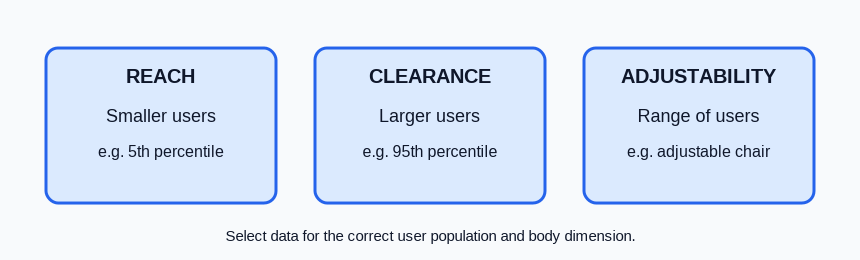
A percentile states the proportion of a measured sample at or below a particular measurement: the 5th percentile is a relatively small body measurement and the 95th a relatively large one. Percentiles are not an average, and the correct population, age group and body dimension must be chosen.
- Clearance: use measurements towards the larger end of the relevant population, for example legroom under a desk or doorway headroom.
- Reach: use measurements towards the smaller end so controls remain accessible, for example a seated reach to a control panel.
- Adjustability: a chair with variable height, seat depth and back support can accommodate a range rather than one 'average' person.
- Safety: finger access to dangerous gaps may require measurements from smaller users including children rather than adult averages.
Designing between the 5th and 95th percentile does not include everyone; accessibility and users outside the chosen range should still be considered.
Ergonomics involves more than body measurements
Ergonomic design also addresses posture, repeated movement, required force, grip texture, control placement, visibility, feedback, cognitive workload and user error. A handle can fit a user's hand anthropometrically yet still be uncomfortable if it demands excessive grip force or awkward wrist posture.
Design process: identify users and tasks → select relevant body data → prototype adjustable or scaled components → test with representative users → revise dimensions and control positions.


Think you have got this topic?
Test yourself before moving on, or use flashcards for a quick recall session.